
From M+20 to T+1: Why eSM Is the Missing Link in Accelerated Energy Settlement
This article is the second part of our eSM series exploring settlement risk in OTC energy markets. It focuses on operational readiness for faster...

1 min read
Jens Bartenschlager
:
Feb 4, 2026 3:58:01 PM
Settlement is the critical final stage of the trade lifecycle, where notional P&L becomes actual cash flow and physical title transfer. It is also the point at which traders face the greatest risk: the potential loss of the full value of a delivered commodity if settlement fails.
In today’s market, shaped by volatility, broader participation, and the aftershocks of the 2022 liquidity crisis, settlement is no longer a back-office checkbox. Instead, it is a trader’s imperative, requiring an understanding of settlement risk. This includes settlement timing risk (Herstatt Risk) embedded in M+20 cycles, along with the automation tools needed as markets accelerate toward T+1 settlement.
To understand this pressure point, its necessary to distinguish between the key categories of risk embedded in OTC energy settlement:
1. A Taxonomy of Settlement Risks
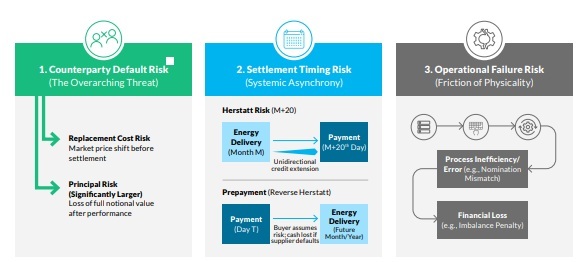
In OTC energy trading, risk is a triad of distinct exposures: Counterparty default risk, settlement timing risk, and operational failure risk. Counterparty default risk encompasses both replacement cost and principal risk, with principal risk exposure typically far larger.Settlement timing risk is a systemic exposure codified in the EFET Agreement. According to EFET, European power and gas contracts typically settle on the 20th of each month following delivery (M+20).
The seller delivers continuously, while the buyer pays with a delay, creating a unidirectional credit extension. This asynchronous structure embeds Herstatt risk over weeks, rather than days, exposing market participants to full principal loss if a counterparty defaults between delivery and payment. Operational failure risk arises from system failures, human error, or process inefficiencies that can translate directly into financial loss under strict grid-balancing rules.
2. Settlement Risk Mitigation
Effective mitigation relies on legal structures (contract text) and active credit management, through:
▪ Close-Out Netting: This is the most critical mitigation tool. It is the legal right to offset mutual obligations upon default. However, enforceability varies by jurisdiction, as some bankruptcy laws prioritize gross asset recovery. Risk managers rely on legal opinions to determine whether credit limits can be set on a net basis, thus enabling liquidity, or must remain gross, restricting trading.
Read the full digital article in the 4 February edition of FORRS magazine (pages 30–31) by clicking here.
This article is the second part of our eSM series exploring settlement risk in OTC energy markets. It focuses on operational readiness for faster...

This article is part of our a tw-part series that provides a comprehensive analysis of the settlement risk landscape within OTC energy markets,...
Yesterday, July 23, 2025 the White House has unveiled "Winning the Race - America's AI Action Plan". The plan is framed as a national imperative to...