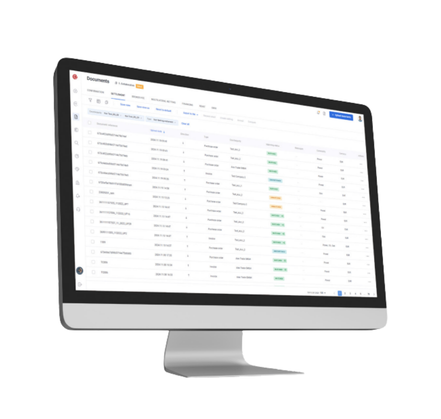



- The Complete Guide -
Electronic Settlement Matching for Energy Trading
Every OTC energy trade creates a chain of post-trade obligations: confirmations, invoices, reconciliations, netting, and payments. When any link in that chain relies on spreadsheets or email, errors compound, disputes escalate, and working capital sits idle.
Electronic settlement matching (eSM) eliminates these bottlenecks by automatically comparing trade records, invoice data, and payment information across counterparties, in seconds, not days.
This guide explains how eSM works, why it matters for energy trading companies, and how the standard is transforming post-trade operations across European energy markets.
In this guide:
1. What Is eSM?
2. How eSM Works: The Settlement Matching Process
3. Why Manual Settlement Processes Fail in Energy Trading
4. Five Benefits of Automated Settlement Matching
5. The EFET eSM Standard: An Industry-Wide Framework
6. What to Look for in Energy Trading Settlement Software
7. How Fidectus GEN Automates Post-Trade Settlement
What Is electronic Settlement Matching (eSM)?
eSM is the automated process of comparing financial data, trade records, invoices, and payment details, between counterparties to confirm that both sides of a transaction agree before payment is released.
In traditional workflows, back-office teams manually cross-reference data from trading platforms (ETRM systems), accounting software, invoicing tools, and bank records. electronic Settlement Matching replaces this manual comparison with an automated system that ingests data from multiple sources and flags discrepancies instantly.
An eSM system typically validates:
- Trade volumes and prices against confirmed deal terms
- Invoice amounts against calculated settlement values
- Payment due dates and currency details
- Netting positions across multiple trades / invoices with the same counterparty.
When all data points match, the system confirms the settlement automatically. When they don’t, it routes the discrepancy to the appropriate team with full audit trail visibility.
eSM in Practice: Video Series with Energy Traders Europe
How eSM Works: The Settlement Matching Process
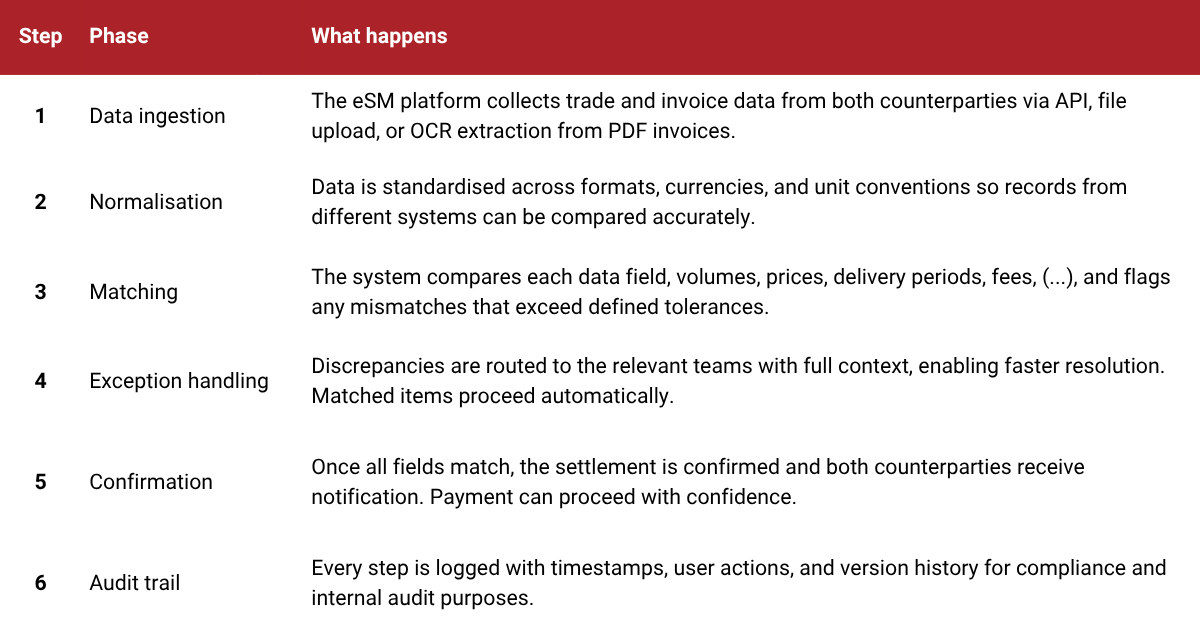
Understanding the settlement matching workflow helps clarify where automation delivers the most value. Here is how a typical eSM cycle operates:
|
Step |
Phase |
What happens |
|
1 |
Data ingestion |
The eSM platform collects trade and invoice data from both counterparties via API, file upload, or OCR extraction from PDF invoices. |
|
2 |
Normalisation |
Data is standardised across formats, currencies, and unit conventions so records from different systems can be compared accurately. |
|
3 |
Matching |
The system compares each data field, volumes, prices, delivery periods, fees, etc., and flags any mismatches that exceed defined tolerances. |
|
4 |
Exception handling |
Discrepancies are routed to the relevant teams with full context, enabling faster resolution. Matched items proceed automatically. |
|
5 |
Confirmation |
Once all fields match, the settlement is confirmed and both counterparties receive notification. Payment can proceed with confidence. |
|
6 |
Audit trail |
Every step is logged with timestamps, user actions, and version history for compliance and internal audit purposes. |
Why Manual Settlement Processes Fail in Energy Trading
Many energy trading companies still manage settlement workflows through spreadsheets, email, and manual data entry. This approach may work at low volumes, but it breaks down as trade complexity and counterparty counts grow.
The hidden cost of manual settlement
Manual processes introduce risk at every handoff. A single transposition error in a spreadsheet can cascade into an incorrect invoice, a disputed payment, and days of reconciliation. Multiply that across hundreds of trades per month with dozens of counterparties, and the operational burden becomes unsustainable.
Common failure points in manual settlement workflows:
- Duplicate data entry across ETRM, accounting, and invoicing systems
- Wrong or outdated price curves applied
- Version control problems when settlement data is exchanged via email attachments
- Delays in identifying mismatches that tie up working capital
- No audit trail, making it difficult to trace the origin of errors or demonstrate compliance
- Staff dependency, where critical knowledge lives in individuals rather than systems.
These inefficiencies don’t just cost time. They erode counterparty trust, delay cash collection, and expose companies to regulatory risk.
5 Benefits of Automated eSM
1. Faster settlement cycles and improved cash flow
Automated matching eliminates the days-long back-and-forth of manual invoice validation. When Alpiq an RWEST, two of Europe’s leading energy traders, adopted electronic Settlement Matching on the Fidectus GEN platform, invoices began reaching counterparties in approximately one second, compared to the hours or days required by email-based processes.
2. Fewer errors, fewer disputes
Every manual data transfer is an opportunity for error. Automated matching compares source data directly, removing the transcription layer entirely. This reduces invoice disputes and the operational cost of resolving them.
3. Full audit trail and regulatory readiness
Every matching decision, exception, and resolution is logged automatically. This gives compliance teams a complete, timestamped record for internal audits and regulatory reporting under frameworks such as REMIT and EMIR. No more reconstructing settlement history from email chains.
4. Working capital optimisation
Delayed settlements lock up working capital. When matching happens in real time, companies can accelerate payment cycles and improve liquidity forecasting. This is especially valuable in volatile energy markets where capital efficiency directly impacts trading capacity.
5. Scalability without headcount growth
As trading volumes grow, manual settlement processes require proportionally more staff. Automated eSM systems scale with volume, not headcount. Companies can onboard new counterparties and expand into additional commodities without rebuilding their back-office team.
The EFET eSM Standard: An Industry-Wide Framework
The European Federation of Energy Traders (EFET) finalised the electronic Settlement Matching standard in April 2019, creating a common protocol for how counterparties exchange and validate settlement data electronically.
The EFET eSM standard defines how trade and invoice data should be structured, transmitted, and matched, enabling interoperability between different trading systems and platforms. This means companies using different ETRM, settlement or accounting systems can still match settlements electronically, provided they connect through a standards-compliant platform.
Why the EFET standard matters:
- Interoperability: counterparties don’t need to use the same system to match settlements
- Lower integration costs: standardised data formats reduce custom development
- Market confidence: adoption by major European energy traders validates the approach
- Future-proofing: the standard evolves with market needs through Enefrgy Trader Europe’s (formerly EFET) Operational Committee.
Fidectus’ GEN platform was the first to bring the EFET eSM standard to commercial operation in April 2020, with leading European OTC energy traders transitioning from pilot to live use.
What to Look for in Energy Trading Settlement Software
Not all settlement platforms are built for the complexity of OTC energy trading. When evaluating energy trading settlement software, these capabilities matter most:
|
Capability |
Why it matters |
|
Multi-commodity support |
Energy traders deal in power, gas, LNG, carbon, and other energy products. Your platform should handle all of them without separate workflows. |
|
Multi-format and multi-channel processing
|
Not all counterparties operate electronically. Energy trading companies must handle a mix of eSM, new e-invoicing standards, or PDF/email. A modern platform should process all formats in a single system, enabling seamless operations across all counterparties without forcing standardisation upfront. |
|
Integrated e-invoicing and invoice processing
|
Invoices sit at the centre of settlement workflows. A modern platform must support both structured e-invoicing and PDF-based invoices, converting them into consistent data for validation and reconciliation. This enables end-to-end automation from settlement to invoicing without manual intervention. |
|
Flexible connectivity |
API, file upload, and OCR extraction ensure every counterparty can participate, regardless of their technical maturity. |
|
Standards compliance |
EFET eSM support ensures interoperability across the market and protects your investment against proprietary lock-in. |
|
Integrated confirmation matching |
Settlement matching is most effective when it’s connected to upstream confirmation (eCM), reducing data re-entry and reconciliation gaps. |
|
Regulatory reporting |
Built-in REMIT and EMIR reporting eliminates the need for separate compliance tools and reduces reporting risk. |
|
Netting capabilities |
Automated netting across trades with the same counterparty reduces payment volume and simplifies cash management. |
|
Security and certification |
ISO 27001 certification and robust access controls are non-negotiable for handling sensitive financial data. |
How Fidectus GEN Automates Post-Trade Settlement
Fidectus built the Global Energy Network (GEN) specifically for OTC post-trade operations in energy and commodities markets. GEN is not a generic financial tool adapted for energy, it was designed from the ground up to solve the problems energy traders face every day.
Unlike standalone settlement tools, Fidectus GEN connects confirmation, settlement, invoicing, and regulatory reporting in a single platform.
GEN’s three integrated hubs cover the full post-trade lifecycle:
- Confirmation Hub: Confirmation Matching across all commodities and counterparties, replacing manual confirmation workflows (supporting eCM and PDF/E-mail).
- Settlement Hub: EFET-standard electronic settlement matching with automated invoice issuance, validation, and exception management, supporting both electronic (eSM/eCM) and non-electronic (PDF/email) workflows within a single platform.
- Regulatory Reporting Hub: Integrated REMIT (II) and EMIR/UK EMIR-REFIT transaction reporting as an ACER-registered RRM provider.
“It is amazing seeing the first invoice reaching Fidectus platform in 1 second and be sure that the invoice flows to the customer at the same time, without sending emails and with a great audit trail.”
- Lorenzo Celio, Head Back Office Coordination, Alpiq
“Fidectus’ solution as well as experience was of great support for us when moving from a manual wholesale energy settlement process to a fully digital and automated one.”
- Henriette Anzböck, Head of Back Office, Alpiq
Companies including Alpiq, Primeo Energie, and RWEST have adopted Fidectus GEN for their post-trade operations. The platform’s OCR capability also means even the smallest market participants can digitise paper-based invoices and participate in electronic matching without a full system integration.
Ready to automate your settlement workflow?
FAQ
-
What is the difference between eCM and eSM?
electronic Confirmation Matching (eCM) validates the trade itself, confirming that both counterparties agree on the terms of a deal. electronic Settlement Matching (eSM) happens later in the post-trade cycle, validating that invoices and financial data match the confirmed trade terms before payment is made. Both are essential for a fully automated post-trade workflow.
-
What is the EFET eSM standard?
The EFET electronic Settlement Matching standard is a protocol developed by the European Federation of Energy Traders that defines how settlement data should be structured, exchanged, and matched between counterparties. First released in April 2019, it enables interoperability between different trading systems and platforms.
-
How does eSM reduce operational risk?
eSM reduces operational risk by eliminating manual data entry, providing real-time mismatch detection, and maintaining a complete audit trail. Errors that would previously go undetected until payment disputes now surface immediately, allowing teams to resolve issues before they escalate.
-
Do both counterparties need to use the same platform?
No. Standards-compliant platforms like Fidectus GEN support multiple connectivity options, including API integration, file upload, and OCR extraction from PDF invoices. This means counterparties with different matching providers, ETRM, settlement, or accounting systems and varying levels of technical capability can all participate in eSM.
-
Which commodities does eSM cover?
eSM applies to any OTC-traded commodity with post-trade settlement obligations. In energy markets, this includes power, natural gas, LNG, emissions certificates, and financial products. The Fidectus GEN platform supports all major energy and commodities classes.
eSM is no longer a pilot project, it is a core component of modern post-trade automation.
The real advantage comes from integrating eSM with confirmation, invoicing, and regulatory reporting in a single platform.
Fidectus GEN enables this end-to-end approach, helping energy trading companies automate workflows, reduce risk, and operate efficiently across all counterparties.
Want to see how this can work for your trading operations?
Talk to our team.