


The REMIT II ‘’deadline paradox’’: why some OTC traders now have a clearer T+10 deadline
REMIT II sets T+2 for standard contracts and T+10 for non-standard. For some bilateral OTC trades that means more time, not less. Here's what changes.

Martin Teci, 19 November 2026
ACER published TRUM v8 on 29 October 2026, and most of its changes apply from 29 October 2027. But one important step comes sooner: eligibility for 2027 exposure reporting is assessed using positions held at 31 December 2026. If nobody in your organisation owns that year-end snapshot yet, now is the time to assign it.
TRUM v8 and ACER's first package of revised guidance make the next phase of REMIT II concrete: expanded transaction data, an integrated LNG reporting route, new exposure reports and periodic reporting for qualifying large final consumers. Several of these changes depend on data that may sit outside today's reporting feed.
Below, we cover what is new, which dates matter, and what to check now in your contracts, data sources and reporting ownership.
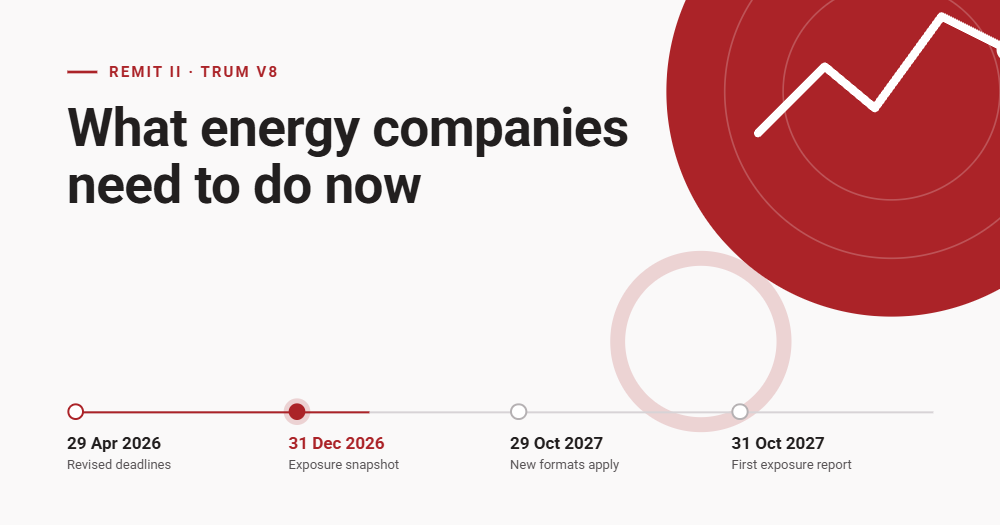
Start with the dates: not everything waits until 2027
The most important takeaway from ACER's revised guidance is that application dates and first submission deadlines are different milestones. Some obligations already apply today; others require preparation before the end of 2026.
The revised T+2 and T+10 working-day reporting deadlines have applied since 29 April 2026. TRUM v7 remains applicable to existing transaction formats until the new requirements take effect on 29 October 2027. And your 2027 exposure eligibility is determined by positions held on 31 December 2026.
|
Date |
Milestone |
What to do |
|
29 April 2026 |
Revised T+2 and T+10 deadlines apply |
Verify current contract classification and deadline calculations |
|
31 December 2026 |
Snapshot date for 2027 exposure eligibility |
Preserve the relevant year-end positions |
|
1 January 2027 |
Exposure provisions apply |
Carry out the threshold assessment in early 2027 using the year-end snapshot |
|
29 October 2027 |
New transaction formats, LNG route and large-consumer periodic regime apply |
Have data mappings, responsibilities and lifecycle processes ready |
|
31 October 2027 |
First exposure report due |
Report Q3 2027 positions across the next 18 delivery months |
|
31 January 2028 |
First large-consumer periodic report due |
Cover the initial period from 29 October to 31 December 2027 |
Later phases follow: further periodic and fundamental-data obligations from 29 April 2028, and hydrogen reporting from 1 July 2028.
What is new in the reporting formats
TRUM v8 expands the numbered data fields in all four existing transaction tables. These are counts of fields in the regulatory tables, not mandatory inputs on every report. Which fields apply depends on the contract and the trade.
|
Reporting format |
Fields (v7 → v8) |
Main additions |
|
Table 1: supply transactions |
58 → 88 |
Algorithm and liquidity information, third-party accounts, price formulas, index details, optionality and LNG data |
|
Table 2: non-standard contracts |
45 → 51 |
PPA and generation attributes, linked transactions, annual contracted volumes, LNG delivery terms |
|
Table 3: electricity transportation |
58 → 65 |
Participant and OMP identification, auction timetable, capacity information |
|
Table 4: gas transportation |
41 → 45 |
Product type, allocation mechanism, additional capacity, competing-auction links |
ACER has also published two new schemas: REMIT Table 1 LNG for LNG market and trade data, and REMIT Exposure for exposure reporting. The formats remain XML-based, with the exposure schema aligned with ISO conventions.
Why TRUM v8 requires more than a reporting system update
The new fields are not just a schema update. Some of the required information may need to come from teams or systems that do not feed today's reporting process.
The challenge isn't simply accommodating new XML fields. It's ensuring that the right contract, pricing and transaction data is available, accurate and connected to the reporting process.
For reporting and operations teams, this means identifying not only which fields are changing, but also where the information originates and who is responsible for providing it.
Format, classification and deadline are separate decisions
ACER treats contracts traded on an organised marketplace as standard and bilateral contracts as non-standard. But the table a trade is reported in does not follow automatically from that classification.
A worked example: Two companies agree a bilateral power contract directly, outside any marketplace. The price is fixed and the delivery profile is defined. Because price and quantity are set, the trade can be reported in Table 1. Because it is bilateral, it is non-standard, so it follows the T+10 working-day deadline rather than T+2.
A system that infers the deadline from the reporting table alone would apply the wrong deadline.
Flexible bilateral contracts are reported in Table 2, with their executions linked in Table 1. OMPs report the activity on their own platforms, and participants must avoid duplicating those reports.
Getting these three decisions right - which table, which classification and which deadline - is essential for accurate, timely reporting.
Lifecycle events
The existing reporting actions for new transactions, modifications, cancellations and errors remain unchanged. However, ACER provides more detailed guidance on how to report contract changes, correct reporting errors and handle terminations.
Previously reported transactions do not need to be resubmitted automatically, but subsequent updates must follow the new requirements.
Exposure reporting: the preparation starts this year
REMIT II introduces quarterly exposure reports covering 18 forward delivery months, including intragroup positions. For natural gas, exposure includes LNG.
The obligation applies to market participants with annual trading positions of 600 GWh or more, assessed separately for electricity and gas. ACER's guidance specifies a country-level calculation that sums absolute monthly net positions across countries.
For 2027, the assessment uses positions held at the end of 31 December 2026 for delivery or settlement during calendar year 2027. The first exposure report is due on 31 October 2027. It covers Q3 2027 and delivery from October 2027 to March 2029. Q1 and Q2 2027 are not reportable.
In practice, that means the year-end 2026 position snapshot needs an owner and a retention process now. The assessment does not have to be completed on 31 December, but the relevant position data must be preserved.
Two 600 GWh thresholds, two different questions
REMIT II uses 600 GWh in two places, and they measure different things. A company can fall under one, both or neither. Treat them as separate assessments with separate owners:
|
Threshold |
What it measures |
What it triggers |
|
Exposure threshold |
Annual trading positions of 600 GWh or more, assessed separately for electricity and gas |
Quarterly exposure reporting |
|
Large-consumer threshold |
Technical capability of a consumption unit to consume at least 600 GWh per year |
Six-monthly periodic reporting of qualifying bilateral transactions |
LNG and large final consumers: new routes from October 2027
From 29 October 2027, LNG market data moves from TERMINAL to reporting through Registered Reporting Mechanisms (RRMs), using the dedicated LNG schema.
Near-real-time reporting already exists. What changes is how the initial record and later trade updates are linked under the same identifier.
Binding portfolio contracts stay in Table 2. Reportable cargo nominations use the LNG schema and link back to the portfolio contract.
For LNG teams, the priority is to understand how portfolio contracts, cargo nominations and subsequent lifecycle updates connect across existing systems.
Large final consumers
Qualifying bilateral transactions with a consumption unit technically capable of consuming at least 600 GWh per year move to six-monthly reporting from 29 October 2027. Transactions on organised marketplaces stay on the continuous reporting route. The first periodic report is due on 31 January 2028 and covers 29 October to 31 December 2027.
Multiple deliveries under the same contract and delivery point are combined into a single execution report, with separate price and quantity intervals.
Further periodic reporting for balancing, capacity mechanisms and qualifying gas storage follows from April 2028, and hydrogen from July 2028. These later phases will have their own detailed guidance.
What to check now: contracts, data sources and ownership
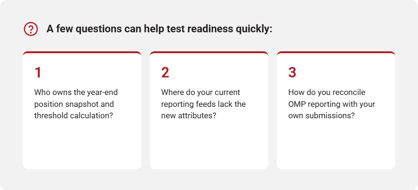
TRUM v8 does not require every company to populate every new field. It does require each company to know which rules apply to it, where the data comes from and who is accountable for it.
These five checks are a practical starting point:
1. Affected contracts. Identify the legal entities, contracts, commodities and reporting routes in scope. Flag PPA, LNG and large-consumer contracts that need different treatment.
2. Thresholds. Assess exposure positions and large-consumer capacity separately, and preserve the 31 December 2026 position snapshot.
3. Data sources. For each newly required data item, locate the source system and name the owner. Some information may sit in trade capture, some in contract administration and some with OMPs.
4. Reporting ownership. Confirm which information you must supply to OMPs and which reports you own yourself, so nothing is missed or duplicated.
5. Migration and testing. Discuss schema migration, updates to existing contracts and the testing approach with your RRM.

Plan the transition together
TRUM v8 gives energy companies the detail they need to prepare their reporting data and workflows for October 2027.
The companies that will find the transition easiest are those that identify their data dependencies and reporting responsibilities early, and plan the change together with their reporting provider.
If you're unsure how the upcoming REMIT II changes will affect your reporting processes, or need support preparing for the new requirements, our team at Fidectus is here to help. As an ACER-registered RRM, we can help you understand what's changing and what it means for your business.
Prepare for REMIT II reporting changes
Understand how TRUM v8 could affect your contracts, reporting data and workflows ahead of October 2027.
Book a REMIT II readiness discussion with our team to review your reporting requirements, from the year-end exposure snapshot to the contracts and data sources affected by the upcoming changes.
We'll be sharing more insights and practical guidance on the upcoming REMIT II changes in the coming weeks. Stay informed by subscribing to our mailing list to receive the latest updates directly in your inbox.
Regulatory information based on ACER guidance published on 29 October 2026. For the latest reporting requirements and technical documents, see ACER's official REMIT reporting guidance.
REMIT II sets T+2 for standard contracts and T+10 for non-standard. For some bilateral OTC trades that means more time, not less. Here's what changes.
REMIT II becomes operational on 29 April 2026. Understand what the new regulations mean, key timelines, and how they impact post-trade processes.
Listen to our CEO Jens Bartenschlager sharing his expert insights on the energy and commodity markets in 2023 on the CTRM Radio Podcast.