4 min read

eSM is a compliant e-invoicing format - whether you adopt or receive it

eSM is a compliant e-invoicing format - whether you adopt or receive it
7:25


Germany's move to mandatory e-invoicing has been forcing a lot of wholesale energy firms to ask an uncomfortable question: does our existing settlement infrastructure survive the transition, or are we about to be pushed onto something new?

For anyone running on electronic Settlement Matching (eSM), Energy Traders Europe has now given a clear answer - and it's the one the market wanted.

The short version: eSM is a compliant e-invoicing format under German law, and it will be treated as one. If you adopt it, you get compliance plus automated matching and netting on top. If you don't, you still need to be able to receive and process eSM invoices, because your counterparties will be sending them.

The clarification

In an update published in April 2026, Energy Traders Europe confirmed that the eSM standard remains an eligible e-invoicing format under the German VAT Act (UStG), even after the mandatory e-invoicing regime takes effect on 1 January 2027. The clarification follows directly from guidance the German Federal Ministry of Finance (BMF) issued on 15 October 2025 covering the rollout of mandatory e-invoicing.

In practice, that means eSM invoices don't need to be replaced by a different format to stay compliant. They can continue to be agreed bilaterally between the invoice issuer and recipient, exactly as they are used today.

Why eSM qualifies

The BMF's October 2025 letter set out two conditions under which a structured e-invoice format is allowed to deviate from the European standard EN 16931:

  1. It must be agreed between the business partners (Section 14 Abs. 1 Nr. 2 UStG).
  2. It must allow full extraction of the UStG's mandatory invoice data into an EN 16931-compliant or interoperable format (Section 14 Abs. 15 Satze 2 and 3 UStG).

eSM - a structured, XML-based data format first published in 2019 - was built to carry every piece of information required under German VAT law and to make that data fully and correctly extractable. That's precisely what satisfies Section 14 UStG and clears both conditions above. As Energy Traders Europe put it, the standard has spent years ensuring efficient, encrypted, automated reconciliation of settlement data across the wholesale energy market, and the BMF's approach lets it keep working as a genuine e-invoicing format going forward.

The part other e-invoicing formats don't have

Most e-invoicing formats stop at issuance. eSM doesn't. Because the standard was designed around matching settlement data between counterparties, it also enables automated incoming-invoice verification - checking what you've received against what you expect, without manual reconciliation. That's a real operational edge heading into a compliance deadline that's otherwise mostly about paperwork.

Interoperability is the proof, not just the promise

"Interoperable with EN 16931" is an easy thing to claim and a harder thing to demonstrate. Energy Traders Europe backs it up with two concrete pieces of documentation:

  • An eSM-EN 16931 Syntax Mapping (Version 1.1), published in November 2025, which documents interoperability with Peppol BIS 3.0.
  • An eSM mapping table (updated April 2026) that lines up every interoperability-relevant eSM field against both the UStG's mandatory invoice fields and the corresponding EN 16931 Business Terms.

Together, they give market participants - and their auditors - a field-by-field paper trail rather than a general assurance.

Beyond Germany: this is a Europe-wide shift

Germany is the first country where the eSM question has been settled this concretely, but it won't be the last time it comes up. As Stuart Beeston, Operations Committee Secretary at Energy Traders Europe, puts it:

"Electronic Settlement Matching has always benefited energy traders by reducing costs, eliminating manual errors, enabling growth, and improving cashflow. Over the next few years, the European Union's e-invoicing initiative will impact all businesses by requiring that they send and receive invoices electronically. The timing will differ by country, but almost everyone will be affected over the next couple of years. Even if you're outside the EU, your counterparts are going to expect you to be e-invoicing ready. eSM will be e-invoicing ready."

That's the wider context worth keeping in view: the German mandate is one deadline among several that will land across Europe over the next few years, and counterparties operating anywhere near the EU will feel the pull toward e-invoicing readiness regardless of their own local rules. Firms already on eSM aren't just clear for Germany - they're starting the rest of that transition from a position most of the market hasn't reached yet.

Continuing your post-trade digitalisation? Join our upcoming webinar with Skribble on qualified e-signatures. Register here.  

Not adopting eSM? You still need to be able to process it

The German regime splits the obligation in two: the duty to receive structured electronic invoices has applied to every domestic business since 1 January 2025, while the duty to issue them phases in from 1 January 2027. Receiving capability is therefore already the baseline, not the future state.

In wholesale energy, a growing share of those inbound invoices will arrive as eSM - it is the format the market already settles on, and the one Energy Traders Europe has now confirmed as eligible. Firms that adopt it capture the upside: automated matching, netting, faster invoice verification. Firms that don't still have to take the format in and process it cleanly, or they become the bottleneck their counterparties have to work around.

What this means for market participants

Energy traders, suppliers, and other wholesale counterparties now have planning certainty on a question that's been an open item on plenty of 2027-readiness checklists. Energy Traders Europe is recommending that companies actively evaluate eSM as part of their e-invoicing transition, specifically to capture the process advantage of faster, automated invoice checking rather than treating the mandate as a reason to bolt on a separate, standalone e-invoicing tool.

For firms already settling trades on eSM, that's the best kind of regulatory news: nothing to migrate, and a genuine reason to lean further into the standard rather than away from it.

Getting onto eSM with the Fidectus Settlement Hub

For everyone else, adoption doesn't have to be an IT programme. The Fidectus Settlement Hub connects market participants to eSM without ripping out the ETRM, billing or ERP systems already in place - which keeps the effort, the timeline and the cost well below what building eSM handling in-house would take.

And because the Hub covers the settlement process rather than just the invoice exchange, participants get more than a compliance tick: automated settlement matching against counterparty data, netting across invoices, and straight-through processing of both outgoing and incoming invoices. The 2027 mandate is the deadline. The process advantage is the reason to move earlier.

Contact our Sales team to learn more.

ETW Reflections: Embracing Change and New Connections

1 min read

ETW Reflections: Embracing Change and New Connections

As Energy Trading Week wrapped up yesterday, it’s a moment to reflect on the insightful discussions, valuable connections made, and exciting...

Read More
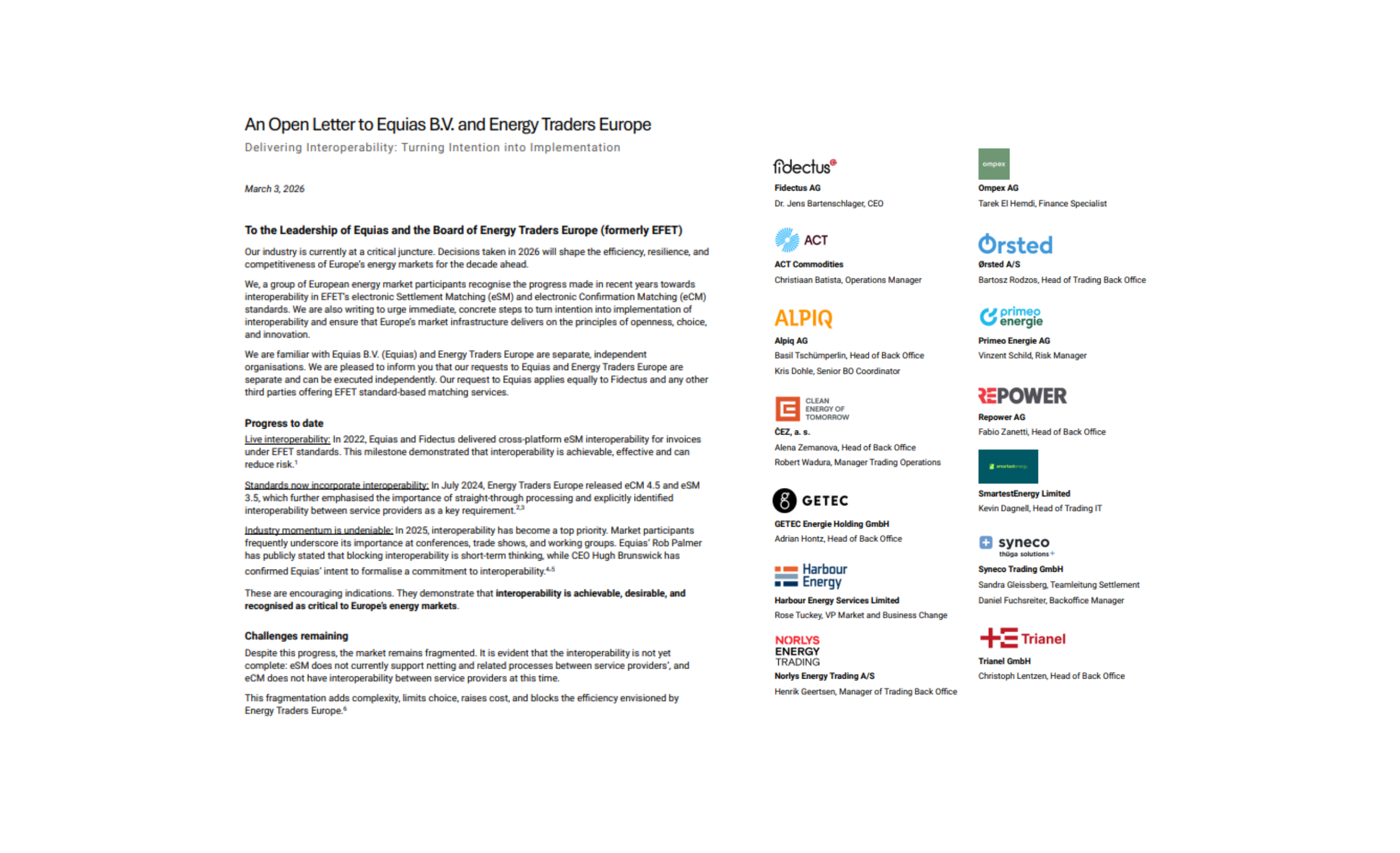
Interoperability in Energy Trading: Open Letter to Energy Traders Europe and Equias

1 min read

Interoperability in Energy Trading: Open Letter to Energy Traders Europe and Equias

Delivering Interoperability: An Open Letter to Energy Traders Europe and Equias B.V. Published: 3 March 2026 | Fidectus AG

Read More
Interoperability in European Energy Markets

1 min read

Interoperability in European Energy Markets

In today’s fast-moving energy trading markets, one fact is undeniable: interoperability is not just important, it’s mission-critical.

Read More