3 min read

The AI Economy 2030: The End of Cognitive Primacy?

The AI Economy 2030: The End of Cognitive Primacy?
6:25

Five findings from Economic Scenarios for Transformative AI (Korinek, Jones, Sacher, Cotter, McCrory) and what they mean for us as decision-makers in energy trading.

1. The moment before the storm

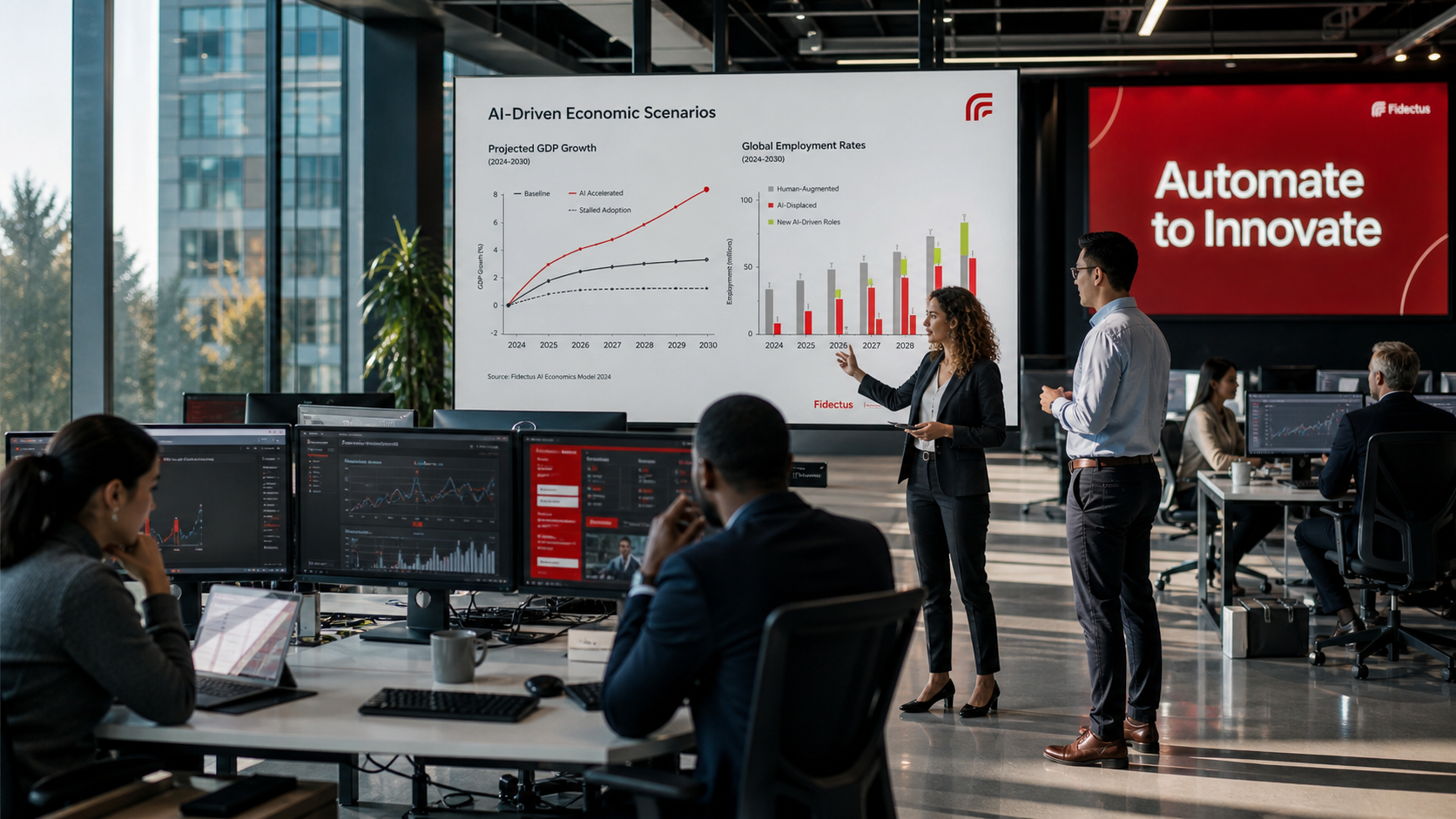
A deceptive calm sits in the C-suite. Labour markets still look stable. That is not evidence of harmlessness, but the eye of the storm. The model runs show: through the end of 2027 the effects stay muted. After that, the paths diverge.

The uncomfortable question is not whether AI arrives. It is: are we ready for a world in which, in the extreme scenario, GDP can grow at around 15% a year and nearly one in five knowledge workers is out of work? Whoever has not rebuilt the operating model by then is holding a legacy risk in 2030.

2. The innovation trap: deployment beats new ideas

The strategic error: that AI drives growth mainly through new scientific breakthroughs. The paper corrects that. The growth impulse from AI in innovation stays small in every scenario: under one percent of productivity gain.

The reason is the principle of gross complements: physical and cognitive processes are complements. What cannot be executed in the physical world caps the cognitive gain.

For us that means dropping the illusion that R&D alone is the lever and moving to operational excellence and deployment. The engine is the automation of existing cognitive work, not the next idea.

That is post-trade. Confirmation, settlement, matching, netting, working-capital optimisation and reporting are cognitive routine with a physical and regulatory bottleneck. Anyone still printing, mailing and reconciling is not automating. A platform such as the Fidectus Global Energy Network (GEN) - Confirmation Hub, Settlement Hub, Regulatory Reporting Hub - is not an IT project. It is the deployment step the model identifies as the real growth driver: executing existing cognitive tasks end-to-end, counterparty-independent and auditable.

One surprising finding of our model is that the growth speedup from AI in innovation is relatively minor, even in the extreme change scenario.

3. The trades bonus

The career paths we preach are going out of focus. In the extreme scenario, wages in cognitive occupations sit 11.5% below the no-AI path. Physical and interpersonal occupations such as electricians, construction or care rise by around a third.

A shortfall of 11.5% versus the no-AI path, against baseline growth of about 2%, means stagnation or a mild real-wage decline versus today. Whether the transition creates prosperity or destroys it depends on the elasticity of compute capital. If compute stays scarce, wages fall in absolute terms. Only a massive scale-up of hardware makes human labour valuable where AI has no presence: on site, in the relationship, in the liability.

For energy trading organisations this is not a romance of the trades, but a hard priority: treat cognitive back-office capacity not as status but as a cost and risk lever, and automate it where matching, reconciliation and reporting already make that possible.

4. The public as an indicator

The median among 10,980 surveyed US adults sits close to the authors’ substantial change scenario: GDP about 8% higher by 2030. Many institutions still forecast more modestly. The market outside does not.

Three public expectations for 2030 belong on every executive agenda:

  • running an online business with no employees;
  • discoveries at Nobel Prize level;
  • building and running highly complex software products with AI.

If “no-employee businesses” are treated as plausible, thousands of knowledge workers on the line are no longer an automatic advantage. In energy trading that is concrete: touchless confirmation, electronic settlement matching and seamless regulatory reporting are not a nice-to-have. They are the test of whether we scale cognitive work or merely relabel it.

5. From labour to capital

Labour’s share of national income sat near 60% for decades. In the extreme scenario it can fall to 45% by 2030: a transfer of some 15 percentage points of income from payrolls to returns on capital.

Firm value then rests less on human capital than on AI and process capital: compute, data, end-to-end workflows. Anyone still booking confirmations, settlements and regulatory reporting as person-hours is valuing the wrong asset.

A transfer of about 9 percent of GDP, roughly the size of Social Security and Medicare combined, would hold cognitive workers’ income at its no-AI level.

6. The paradox of extreme growth

The extreme change scenario is not a feuilleton. It models measurable parameters: GDP growth of around 15% a year by 2030, a theoretical doubling of per-capita income every five years - and 17.9% unemployment among knowledge workers.

Exploding output, displacement of the cognitive middle: that is the leadership question. Not whether we buy another tool. Whether we build the operating core so that growth does not die in manual reconciliation.

7. The choice of institutions

Until the end of 2027 there is still time to adjust. After that the curves separate. Resources for prosperity can appear in abundance. Our distribution and operating models are not built for that pace.

As CEOs, efficiency in our own P&L is not enough. We have to think the social contract and, in parallel, rewrite the contract inside our own value chain: less cognitive shift work, more capitalised process.

In our market that is not an abstraction. Anyone still running confirmation, settlement and regulatory reporting as a human chain is betting against the paper. Anyone running them as an end-to-end network, independent of format, channel and counterparty, is pulling the lever the authors themselves treat as decisive: automation of existing cognitive work.

The question from today: if GDP rises but traditional knowledge work fades as a source of income and organisation, how do we set the operating model and the contract so that both still hold?

Source: Korinek, Jones, Sacher, Cotter, McCrory, Economic Scenarios for Transformative AI, Anthropic, September 2026.

E-world Insights & Why Fidectus is Excited About the Future

1 min read

E-world Insights & Why Fidectus is Excited About the Future

As we approach E-world 2025, it's clear that this year's event will be a pivotal moment for businesses seeking to stay at the forefront of...

Read More
Energy Trading Week Europe: Building Connections, Driving Innovation

1 min read

Energy Trading Week Europe: Building Connections, Driving Innovation

This year will be my first time at Energy Trading Week (ETW) in London, and I couldn’t be more excited. ETW is a key moment in the energy trading...

Read More